
Hawaii County Directory Years
The historical shelf is a set of checkpoints, not one continuous Hawaii County city directory. The Hawaii State Archives directory guide identifies hard-copy Polk and Husted volumes and selected University of Hawaii scans. The Library of Congress adds a long Hilo and Island of Hawaii telephone-directory microfilm range.
| Collection | Years | Where held | Access |
|---|---|---|---|
| Early Hawaii directory | 1880–1881 | UH eVols | Digitized item |
| Polk and Husted selected volumes | 1884–1913, selected years | Hawaii State Archives | Reading room and linked scans |
| Hawaii directory scan | 1924 | UH eVols | Digitized page images |
| Hilo and Island telephone books | 1921–1956 | Library of Congress | Microfilm collection record |
| Hilo and Honokaa Sanborn maps | 1914–1957, selected dates | Library of Congress and UH guides | Digitized maps and catalog records |
The selected Archives years include 1884–1885, 1888, 1889, 1890, 1892, 1894–1895, 1896–1897, 1898, 1902, 1903–1904, 1904–1905, 1905–1906, 1910, and 1913. Completeness and search quality vary. No official catalog reviewed supplied a precise Hilo reverse-directory run or obituary-index year list.
A year in the table means an institutional source identified that volume or run. It does not guarantee a complete island listing, a resident-only list, or full-text name search. Publication date also matters. Someone who arrived late in the year may first appear in the next volume, while a stale business or phone listing may persist after a change.
Open Hawaii County Archives Volumes
The State Archives is the primary physical keeper for the Polk and Husted city directories named in the official guide. The reading room is at 364 South King Street in Honolulu, with general weekday hours of 9 a.m. to 4 p.m. and phone assistance at (808) 586-0329. Contact staff before travel to confirm the needed year and access condition.
The 1904–1905 and 1905–1906 volumes make a useful pivot. Hawaii County formed in 1905, so a person near that date may appear under territorial or older local language in one volume and county-era wording in the next. That shift does not prove a move. Compare the exact locality heading, office name, spelling, and source date.
The manifest image shows the State Archives city directory holdings page.
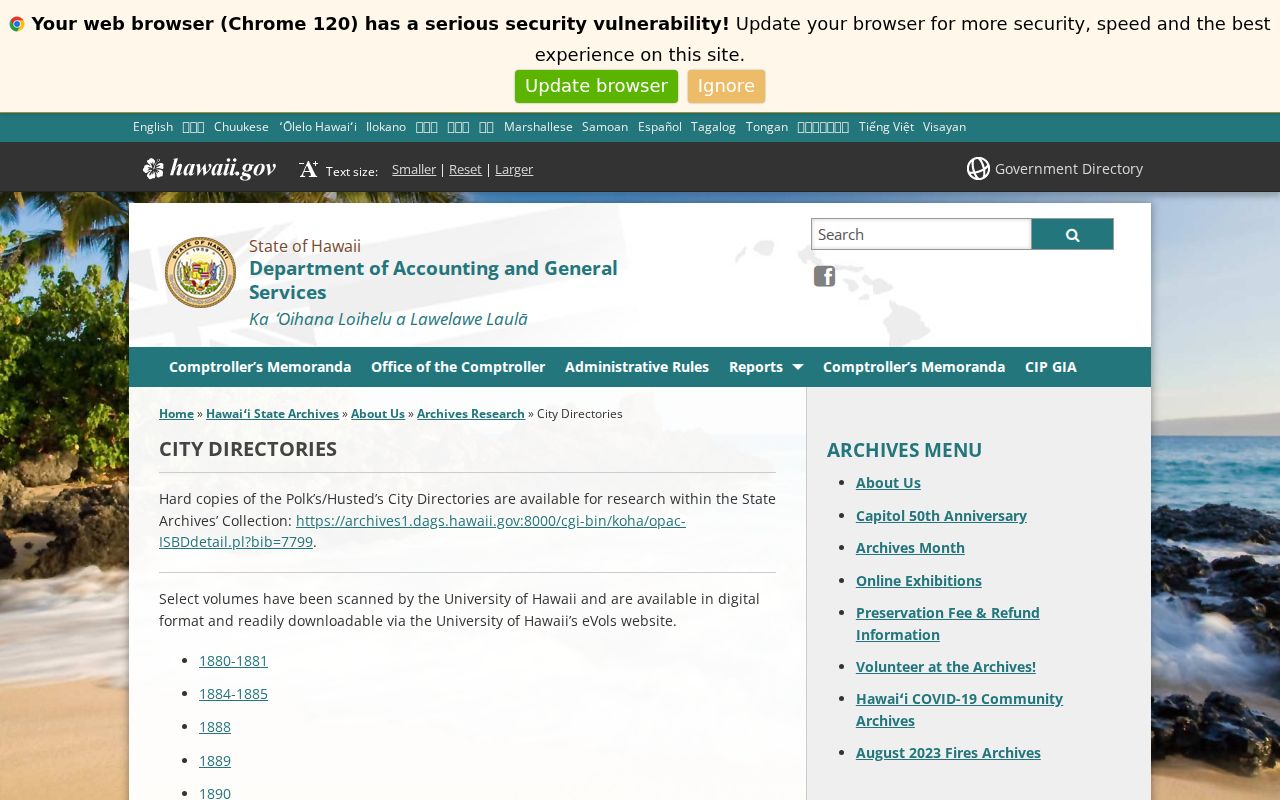
Use the list to select a volume, then cite its year and page rather than citing only the landing page.
Read Hawaii County Directory Scans
The 1880–1881 directory gives early island-wide names, occupations, businesses, and community labels, though street detail may be sparse. The 1924 directory is a stronger bridge to address and business research. Both should be read as page images.
Optical character recognition can misread initials, numerals, ʻokina, and macrons. Search multiple spellings, then inspect the printed line and nearby heading. Record the volume, page number, exact spelling, locality, and whether the item is an individual, household, business, institution, or advertisement. A scan result without that context is too easy to misidentify.
Bridge Hawaii County Directory Decades
The Library of Congress record for Hilo and Island of Hawaii telephone directories spans November 1921 through May 1956. This run bridges the gap between older State Archives volumes and modern parcel records. White pages can carry subscriber names, phones, and address lines; yellow pages can place a business or institution in its community.
Microfilm cataloging does not mean every page is available as searchable text online. Ask LOC or a library how to reach a particular reel and month. A listing also identifies a telephone subscriber, not every member of a home. Check the street and number against a map, deed, census, or later city directory before drawing a household conclusion.
That run is one of Hawaii County’s strongest local stories: more than three decades of telephone books preserve the link between old road labels, names, businesses, and the island’s changing communities.
Decode Hawaii County Directory Entries
A Hawaii County city directory entry must be transcribed before it is interpreted. The fields differ by year and publisher, so never import a symbol from another volume. Photograph or save the abbreviation key when available, then keep the printed locality heading with the entry.
| Printed name | Exact surname, given name, initials, spelling marks, and variants |
|---|---|
| Role text | Occupation, business, institution, or other descriptor if printed |
| Place line | Street, house number, district, community, or mailing label |
| Telephone | Number when present, tied to the subscriber shown |
| Entry type | Individual, household, business, institution, or advertisement |
| Citation | Volume year, page, locality heading, repository, and date viewed |
- Criss-cross directory
- A directory arranged by street or address. No verified Hilo run with exact years was found in the official catalogs reviewed.
- Householder index
- An address-order or household-oriented list that may complement a surname section.
- Abbreviation key
- The publisher’s legend for shortened words and symbols used in that volume.
An occupation, business, or telephone line is not automatic proof of residence. Preserve the printed role. That small discipline prevents a business address from turning into a false household claim.
Map Hawaii County Directory Names
Modern town strings do not cover Hawaii Island’s older geography. A directory, deed, probate file, or oral history may use an ahupuaʻa, judicial district, ranch, plantation, subdivision, or older road. The UH Hilo place-name guide supports searching traditional and current labels together.
Sanborn sheets help test the physical setting. Library of Congress holdings include Hilo dates in 1914, 1921, and 1957, plus Honokaa dates in 1914 and 1956. A Sanborn map can show a building footprint, street name, use, lot arrangement, or nearby business. It does not name every person inside.
Use a map when an address changes between volumes. Compare the old street, cross street, building, lot, and nearby institution with current GIS. Keep both names and explain the source for the translation.
Ask Hawaii County Library Staff
Hilo Public Library opened on January 20, 1951 and remains a practical first contact for local newspapers, microfilm questions, and unlisted holdings. The UH Hilo genealogy guide points to directories, census records, biographies, oral histories, immigration sources, Archives material, and FamilySearch.
The official pages did not publish a complete Hilo obituary-index year span or a cataloged reverse-directory run. That is a research limit, not proof that staff cannot locate a reel or uncataloged aid. Ask a focused question with the name, date range, community, newspaper, and likely directory year.
The manifest capture shows the Hilo Public Library branch page.
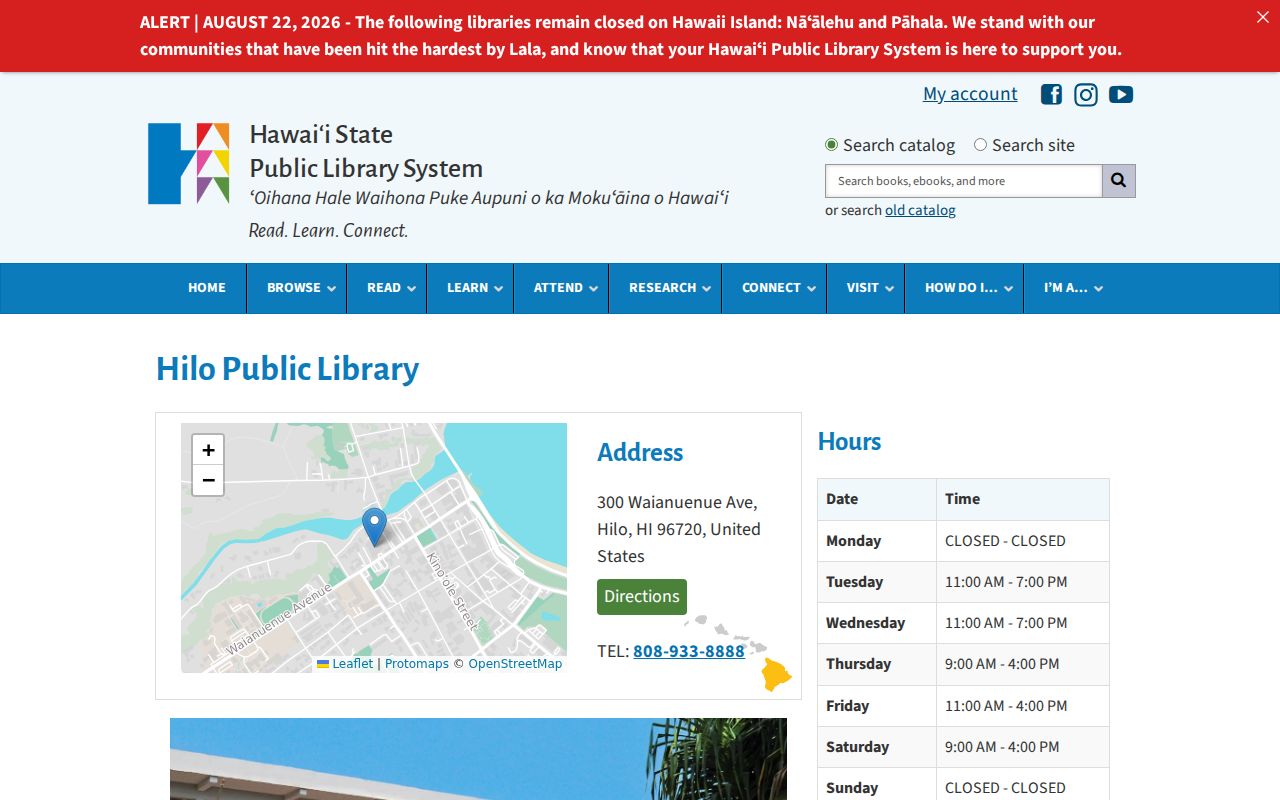
The branch is a contact point for the next shelf or reel, not a promise that every historic name is indexed online.
Trace Hawaii County Family Lines
City directories fill the years between censuses and can show when a name, business, or address first appears or disappears. Hawaii’s early records are uneven, so pair the directory with the source closest to the event. State Archives probate and will material spans 1847–1917 but is incomplete. The Fourth Circuit series includes Hamakua, Hilo, and Puna cases from 1881–1904, with known missing cases.
- Choose the directory year nearest the known event. Search surname variants, initials, business names, and community headings.
- Transcribe the full entry and citation. Inspect the image to correct OCR errors.
- Check the prior and next available directory years. Record moves, role changes, spelling shifts, and gaps.
- Pair the result with the closest released census, deed, probate file, vital index, newspaper, or cemetery folder.
- Use Sanborn and territorial maps to test whether an address or road name still points to the same place.
- When the run ends, ask a librarian or archivist about the exact reel, year, or newspaper rather than filling the gap with a guess.
A missing entry can mean a move, death, unlisted phone, publication gap, spelling problem, or change in who held the subscription. It cannot settle the issue by itself. The strongest family history result is a chain of dated, independently kept records.
Extend Hawaii County City Directories
FamilySearch’s Hawaii collections add births and baptisms, marriages, census records, deaths and burials, and deeds for varying historical spans. Indexing and image access differ, and an account may be required. Search the catalog as well as the name index because not every image has been transcribed.
County cemetery folders offer a distinct local path. A burial entry can connect a person to Alae, Hawi, Honokaa, Kainehe, Keopu, Kukuihaele, Naalehu, Waimea, a veterans cemetery, or another named set, then point toward probate, vital, obituary, and directory research. Treat the plot, date, cemetery, and status as fields from that record, not as proof of every family relationship.
For modern address-keyed parcel and deed work, use the Hawaii County street directory workflow. Historic city directories own the dated shelf; current tax and GIS systems answer a different question.
Early vital reporting has its own limits. Archives finding aids describe laws beginning in 1842, governor registers in 1846, and death-reporting changes in 1850, with underreporting and custody shifts before 1896. When no certificate-style entry appears, check church, missionary, probate, census, deed, newspaper, and governor-register sources. Their roles differ, but together they can explain why a directory name appears in one year and vanishes by the next.
Hawaii County Directory Limits
Hawaii County has no incorporated cities and no separate Hilo city clerk with a municipal resident roll. “City directory” is the historical publication category. County offices serve Hilo, Kona, Puna, Kaʻu, Kohala, Hamakua, and rural communities, while state agencies hold deeds, courts, vital records, and Archives collections.
No county courthouse-fire story was verified in the official sources reviewed. Explain a gap through documented limits: selected publication years, incomplete probate series, unindexed images, off-site files, or a collection that requires reading-room or microfilm access. Do not turn absence into a claim of destruction.
Note: A directory line is a dated snapshot of a named role or subscription, not current proof that the same person occupies the address.